Repair a section, or replace the whole run?
Not every rusty gutter means a full re-gutter. The honest answer depends on how widespread the damage is and how old the rest of the system is. A single length dented by a falling branch or a ladder, on an otherwise sound run less than about fifteen years old, can often be cut out and replaced with a matching length. A leaking corner or stop end can sometimes be re-made without touching the rest.
Where it stops making sense is when rust shows up in several places at once. Gutters corrode from the inside out, usually where wet leaf litter sits against the base, so by the time one hole appears the metal along the rest of that run is often thin as well. Patching one hole on a thirty-year-old run tends to buy a season before the next one opens up a metre along. Colour is the other catch: a new Colorbond® length next to one that has faded for twenty years in Melbourne sun rarely matches, which matters on a front elevation even if it doesn’t at the back.
A reasonable rule of thumb is that if the problems are confined to one length or one corner, and the gutter still holds its shape and fall, a repair is worth pricing. If rust is general, the gutter has sagged between brackets, the joins have been sealed more than once, or the fascia behind it is soft, a full replacement is usually the cheaper outcome over the next ten years. Ask for both options on the quote if you’re unsure, and ask why one is being recommended over the other.
Box gutters on terraces, Edwardians and parapet homes
Many inner-suburban terraces and some Edwardian and interwar homes drain part of the roof into a box gutter — a flat-bottomed channel sitting inside the roof line, often behind a front parapet or between two roof slopes. In suburbs like Richmond, St Kilda, Northcote and Brunswick, it’s common to find box gutters lined in old galvanised steel that have been painted, patched and sealed for decades.
Box gutters fail differently from eaves gutters. Because they sit over the ceiling rather than outside the wall, a leak shows up as a brown stain or drip inside the house, not water on the path. Common causes include a blocked or undersized sump, laps and step joints that have opened up, too little fall along a long run, and an outlet with no overflow so that one plug of leaves sends water back under the roof sheets. A heavy summer downpour is often the first time anyone notices.
Replacing a box gutter usually means lifting the bottom of the adjoining roof sheets or tiles, checking the timber sole boards underneath for rot, and installing a new lining with proper fall, a sump, and an overflow or rainhead so a blockage shows on the outside. On a terrace row, the box gutter may sit on or near the party wall and drain more than one property, so the scope needs to be clear about where your section starts and ends. More detail on re-lining and overflows sits on the roof plumbing Melbourne page; for this page, the key point is that box gutters should be quoted as their own item, not lumped into a per-metre eaves gutter price.
Bayside salt air: steel grade, copper and fixings
Homes close to Port Phillip — around Williamstown, Altona, Brighton, Sandringham, Mentone and Mordialloc — tend to see gutters and fixings age faster than the same product a few suburbs inland. Salt spray settles on the metal and, in places rain doesn’t rinse, such as the underside of the gutter lip and the back of brackets, it keeps working on the coating.
Steel manufacturers publish guidance on which grades suit which distance from the coast, and for homes very close to the water a more corrosion-resistant grade or different material may be recommended. The practical step for you is to ask which grade the quote assumes and whether it suits your distance from the bay. Fasteners and brackets matter just as much: a quality gutter held up by the wrong screws can still fail early.
Copper gutters still appear on some period and architect-designed bayside homes. Copper weathers to a brown, then green, patina and can last a long time, but it needs copper brackets and downpipes and must not drain onto Zincalume®, galvanised steel or Colorbond® below it. If you have copper on one part of the house and steel elsewhere, the order of the water matters. A gentle hose-down of under-eaves surfaces a couple of times a year, from the ground, helps any metal last longer near the coast.
Where new or moved downpipes are allowed to discharge
Adding downpipes is one of the most useful upgrades in a Melbourne gutter replacement, but each new downpipe has to go somewhere sensible. Ideally it connects into the existing underground stormwater line, which runs to the property’s legal point of discharge — usually the street kerb or a council drain or easement. For new connections, extensions and some alterations, councils can provide legal point of discharge information for a property, and your plumber will work to the stormwater drainage standard used across Australia.
What a downpipe shouldn’t do is empty onto a neighbour’s land, run across a shared driveway, or dump concentrated water against your own slab or a timber stump. A downpipe ending in a garden bed with no connection may be common, but it can cause soggy ground, cracking and subfloor damp over time. If the old system has a blocked or collapsed underground line, the fix is to clear or repair that line rather than disconnect the downpipe.
Two-storey homes have a quieter version of the same problem: upper-storey downpipes that discharge onto a lower roof through a spreader. Done properly it works, but a large upper roof dumping onto a small lower gutter is a common cause of overflow at one corner. When you replace gutters on a two-storey home in places like Point Cook, Tarneit or Craigieburn, it’s worth asking whether the spreaders and the lower gutter are sized for the water they now take.
Boundary walls, shared gutters and tight inner-suburb access
Older inner-suburb homes and many newer townhouses are built to or close to the boundary. That changes gutter replacement in a few ways. A gutter on a boundary wall can sometimes only be reached from the neighbour’s side, so a polite conversation before the job saves a wasted visit. Where scaffold or a platform has to sit on a footpath or laneway, some councils require a permit for that occupation, which the contractor normally arranges but which can add lead time.
In units and townhouse developments, gutters may be common property managed by an owners corporation, even if they run along your own wall. Check your plan of subdivision or ask the owners corporation manager before booking, so the work is approved and paid by the right party. On attached homes in suburbs like Hawthorn, Elsternwick or Footscray, a shared run is often best replaced in one go with the neighbour’s agreement rather than half at a time with two different profiles meeting in the middle.
Timing a gutter replacement around Melbourne’s seasons
Gutters can be replaced at any time of year, but the calendar does shape the experience. Late summer and early autumn are often comfortable for the work and let you sort the gutters before the main leaf drop in tree-lined suburbs like Kew, Camberwell and Templestowe. Winter rain makes problems easy to see — you can watch exactly where water escapes — though wet, windy days can push dates around.
Spring and early summer bring Melbourne’s short, heavy storm bursts, and demand rises after each one. If a storm has just shown you where the system fails, take photos and video during the rain if it’s safe from the ground, then enquire while the evidence is fresh. On fringe blocks around Eltham, Lilydale and Ferntree Gully, finishing gutter and ember-guard work before the warmer months is the sensible target, so the roof edge is sorted before fire season rather than during it.
After the new gutters go on: the first storm and the first year
The first decent downpour after the job is a free test. From the ground, check that water leaves each downpipe freely, that nothing drips from joins or corners, and that no water spills over the back of the gutter onto the fascia or eaves lining. If something isn’t right, raise it with photos while the installer can still easily come back.
Over the first year, watch for small offcuts or swarf left in the gutter (they can stain new Colorbond®), leaf build-up near valleys, and any tank or first-flush connections that were reconnected. Keep the compliance certificate and quote together. Most new gutters only need a clean once or twice a year on an open block, more under big trees — book that through gutter cleaning Melbourne when it’s due rather than climbing up yourself.
Before you book: a short checklist
- Is this a repair, part replacement or full re-gutter — and why that recommendation?
- Are any box gutters, rainheads or spreaders included, and quoted as separate items?
- Which steel grade and fasteners suit your distance from the bay?
- Where will every new or moved downpipe discharge?
- Does anything need a neighbour, owners corporation or council sign-off first?
If you’d like the work done, enquire here with your suburb, storeys and a few photos, or call 0485 008 178. We organise the inspection and a free measured quote with our roofing partner, and you decide from there.

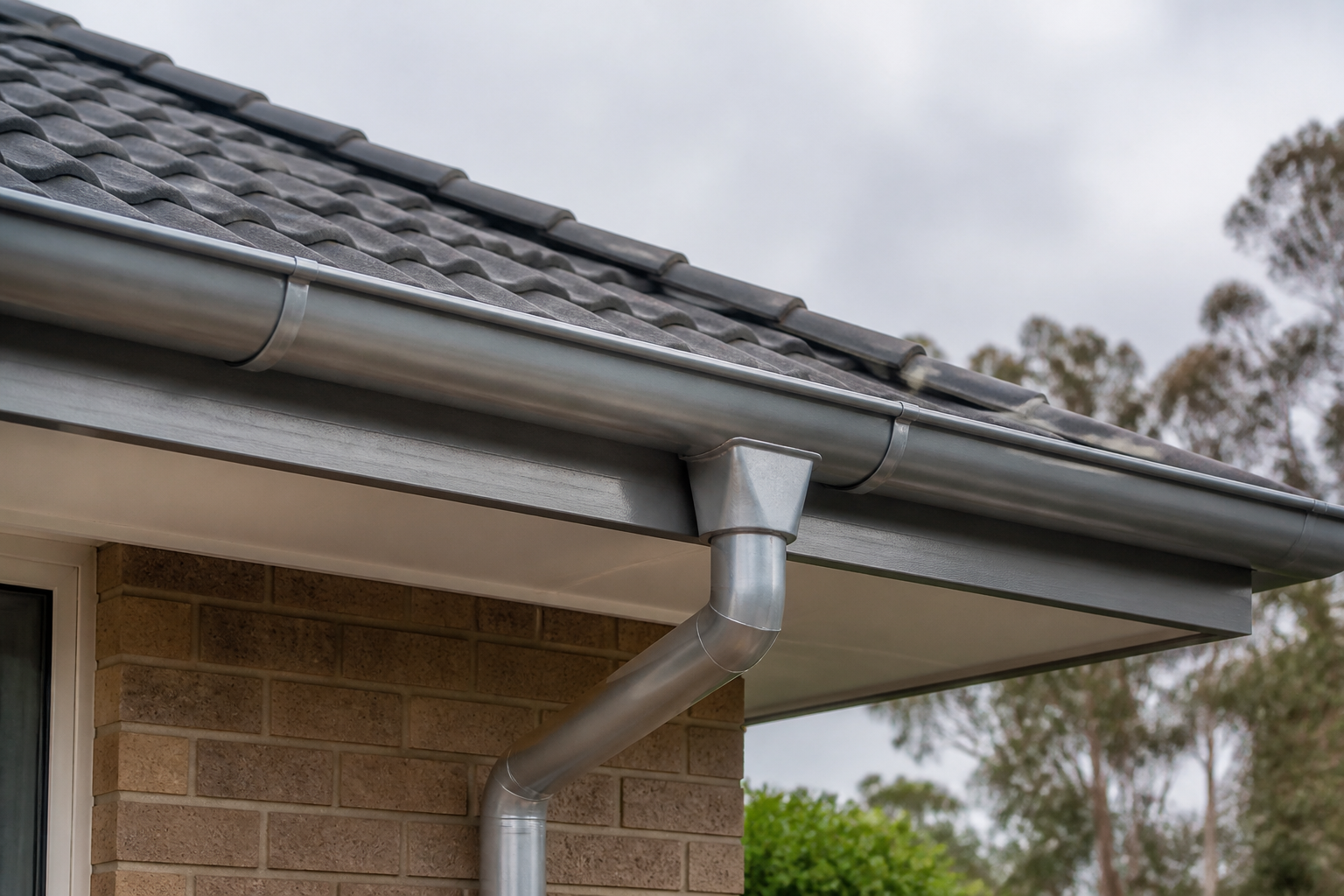 Example job type