Commercial roofing in Melbourne — what it covers
Commercial roofing in Melbourne covers a wide spread of buildings: strip shops with a flat roof behind the parapet, offices and medical suites, childcare centres and clubs, apartment and townhouse blocks run by an owners corporation, and the warehouses and factories that fill the industrial estates in the south-east, north and west. The roofs look different, but the jobs that come up are surprisingly consistent — water getting in where the roof is flattest, at the gutters, and around everything that has been cut through it.
You don’t need to know which trade you need before you enquire. Tell us the building type, the suburb, roughly how big the roof is and what’s happening, and we’ll organise a roofer who works on that kind of roof. If it’s a house rather than a commercial building, roof repairs Melbourne is the better starting point.
The commercial roofs you’ll find around Melbourne
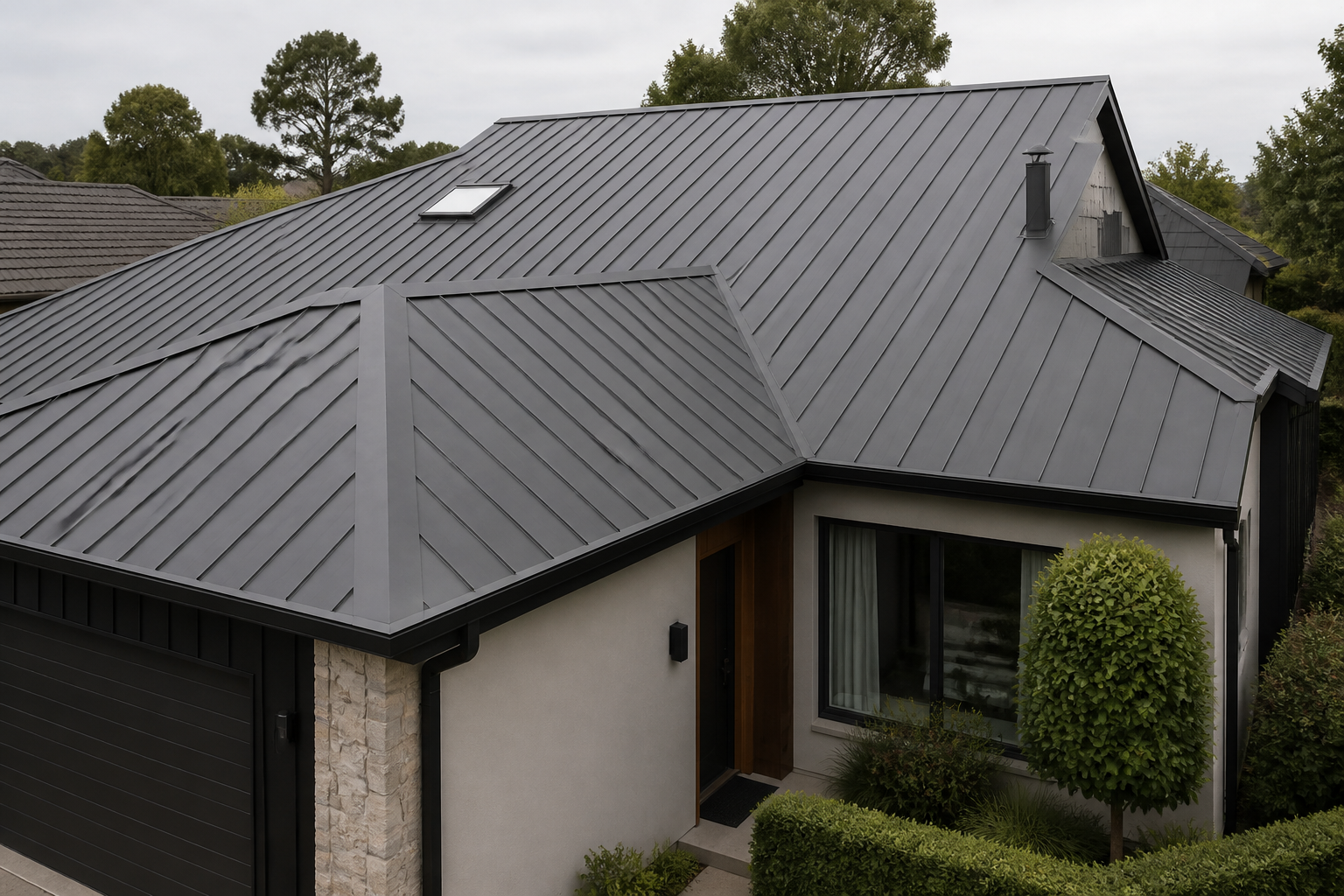
Long-span metal roofs. Most warehouses and factories in places like Dandenong South, Braeside, Laverton North, Derrimut, Campbellfield and Bayswater North are roofed with long runs of metal sheeting at a low pitch. Concealed-fix profiles clip onto brackets with no screws through the pan; pierce-fixed profiles are screwed through the ribs. Both can last decades, but long runs move a lot between a hot northerly afternoon and a cold night, and that movement works on fasteners, laps and flashings. The materials side is covered on metal roofing Melbourne.
Low-pitch roofs behind parapets. Shopping strips along roads like Sydney Road, Chapel Street, Glenferrie Road and Bridge Road often hide a near-flat metal roof behind a decorative parapet, draining into box gutters and rainheads at the back. They’re out of sight, so blocked outlets and rusted gutters often go unnoticed until a ceiling tile drops in the shop.
Membrane roofs on concrete. Newer offices, apartment blocks and podium decks often have a waterproofing membrane — torch-on bitumen, a single-ply sheet or a liquid-applied system — over a concrete slab. Problems tend to show at upstands, outlets, plant platforms and where the membrane laps onto walls.
Older asbestos cement roofs. Plenty of mid-century factories and sheds across Melbourne still carry corrugated asbestos cement sheeting. These roofs need a different plan altogether, covered further down this page.
Why commercial roofs leak
On a house, a leak usually means a cracked tile or a tired ridge. On a commercial roof, the common causes are different:
- Low pitch and long runs. Water moves slowly across a near-flat roof, so any gap at an end lap or fastener has time to let water in, and wind-driven rain can push it uphill.
- Fasteners and washers. Screws loosen with thermal movement and rubber washers perish in the UV, leaving dozens of small entry points across a big roof.
- Penetrations. Air-conditioning units, exhaust fans, flues, conduits and old antenna mounts all cut through the roof. Each one relies on a flashing or sealant that ages faster than the sheet around it, and rooftop plant gets added over the years by trades who aren’t roofers.
- Rust from the details. Metal offcuts and drilling swarf left on the roof, cut edges, and contact between incompatible metals all start rust that spreads along the sheet. Copper pipes or lead flashings draining onto zinc-coated steel are classic examples.
- Condensation. In unlined warehouses and cold rooms, moisture can form on the underside of the sheet and drip, which looks like a leak but needs insulation or ventilation rather than a roof repair.
Box gutters, sumps and overflows — the storm problem
The biggest cause of storm leaks on Melbourne commercial buildings is drainage, not the sheeting. Big roofs collect a lot of water, and on low-pitch buildings it usually runs into box gutters that sit inside the building line, then into sumps and downpipes. Melbourne’s summer thunderstorms can dump heavy rain in a short burst. If a box gutter is blocked with leaves, silt or packaging, undersized for the roof area, or missing a proper overflow, the water rises and spills inside rather than outside.
That’s why the same bays flood in every big storm while the roof seems fine in steady rain. A good inspection checks box gutter condition and falls, sump and outlet sizes, rainhead and overflow provision, and whether downpipes are blocked lower down. Box gutter and stormwater work is roof plumbing in Victoria, done by a licensed roof plumber, and it’s often the first fix that stops repeat call-outs.
Regular clearing matters more on commercial roofs than on houses. Sites near big trees, loading docks where rubbish blows up, and buildings with pigeons all fill box gutters quickly. A clean before winter and another after the main storm months is a sensible minimum for most sites.
Asbestos cement roofs on older Melbourne buildings
If your building went up before the late 1980s, check whether the roof is asbestos cement before anyone goes up. Asbestos products were banned in Australia from the end of 2003, and many older factories, warehouses and sheds across Melbourne were roofed with corrugated asbestos cement sheeting. Under Victorian workplace rules, buildings constructed before 2004 should have an asbestos register. That register is the first thing to look at.
Asbestos cement roofs aren’t safe to walk on. The sheets are brittle with age, and people have died falling through them. They also shouldn’t be pressure-cleaned, drilled or cut. The usual options are encapsulating sheets that are still sound, over-roofing with new metal on a frame above the old sheet, or removal by a licensed asbestos removalist before re-roofing. In Victoria, removing more than 10 m² of non-friable asbestos needs a licensed removalist, followed by a clearance inspection. Mention asbestos when you enquire so the plan and quote reflect it from the start.
Safety and access on commercial roofs
Commercial roofs are where most serious roofing falls happen — through skylight sheets, fragile roofing and unprotected edges. Any reputable roofer will plan the job around edge protection, safety mesh or walkways, anchor points and the right access, whether that’s scaffold, a stair tower or an elevated work platform. High-risk construction work also needs a safe work method statement.
If your roof already has a height safety system, such as anchor points or a static line, let us know and send any recent certification details. It saves time at the inspection. Ask your staff not to go up to look, especially on older roofs with translucent sheets, which are hard to see and easy to fall through.
Strata and owners corporation roofs
Apartment and townhouse roofs are usually common property, so the work goes through the owners corporation. That changes the process. The manager typically needs a clear written scope with photos so the committee can compare it and approve the spend, and sometimes a bigger job waits for a meeting. Access may be through a roof hatch, a lift overrun room or a locked plant area, and residents need notice before work starts.
The roofs themselves range from concrete tile on 1970s walk-up blocks in suburbs like Oakleigh, Box Hill and Preston, through metal on townhouse developments, to membranes on newer apartment buildings. Recurring leaks into top-floor units often trace back to one shared box gutter or outlet, which is why an inspection of the whole roof usually beats chasing it unit by unit.
Repair, re-sheet, over-roof or replace
Most commercial roof problems don’t need a whole new roof. The usual decision runs like this:
- Repair when leaks are local — a lap, a group of fasteners, a flashing, a penetration or a box gutter joint.
- Re-sheet sections when rust is confined to particular runs, often along the low end near the gutter or under old rooftop plant.
- Over-roof when an asbestos cement or badly worn roof is structurally sound underneath and removal would be disruptive or costly.
- Replace when corrosion is widespread, the roof won’t drain properly as built, or you’re upgrading insulation, skylights or solar at the same time. The planning steps overlap with roof replacement Melbourne.
A roof inspection with dated photos is the honest way to decide, and it gives a property manager, owner or insurer something concrete to work with.
Scheduled roof maintenance for commercial sites
A large share of commercial roof leaks are avoidable. A simple maintenance plan for a Melbourne site is a visit in late autumn, before the winter rain, and another after the summer storm season. Each visit clears box gutters, sumps and outlets, checks fasteners, laps, flashings and penetrations, notes any rust starting, and gives you a short report with photos. Small defects get fixed while they’re small, and the report gives you a record for the landlord, the insurer or the owners corporation.
Leases, insurance and who pays
On leased premises, who pays for the roof is set by the lease, so check it before work is booked. Many commercial leases keep structural items like the roof with the landlord and make the tenant responsible for things like keeping gutters clear, but leases vary. For storm and hail damage, your insurer decides what is covered. Dated photos and a written scope help either way. This is general information, not legal advice.
What drives the cost of commercial roofing in Melbourne
Commercial quotes depend on the roof area and profile, the scope (repairs, box gutters, re-sheeting, membrane work or a full re-roof), access and safety setup (edge protection, scaffold, lifts, out-of-hours work), whether asbestos is involved, rooftop plant that has to be lifted or reconnected, and how the work has to be staged around your business. We don’t publish a flat price because those factors move the number a long way. You get a scoped quote after an inspection.
Call 0485 008 178 with the building address, building type and a few photos. We aim to call back the same business day — usually within a few hours.

 Example job type